§ 02RainbowCity Subjectivity Trilogy · Book 2

Rebuilding Our Cognitive OS

《重建我们的认知 OS》

KunYuan

A philosophical primer on how Human cognition is formed, stabilized, and sometimes rebuilt — without reducing the Human to a system.

Forthcoming December 2026 RainbowCity Press TRANTOR LABS PRIVATE LIMITED
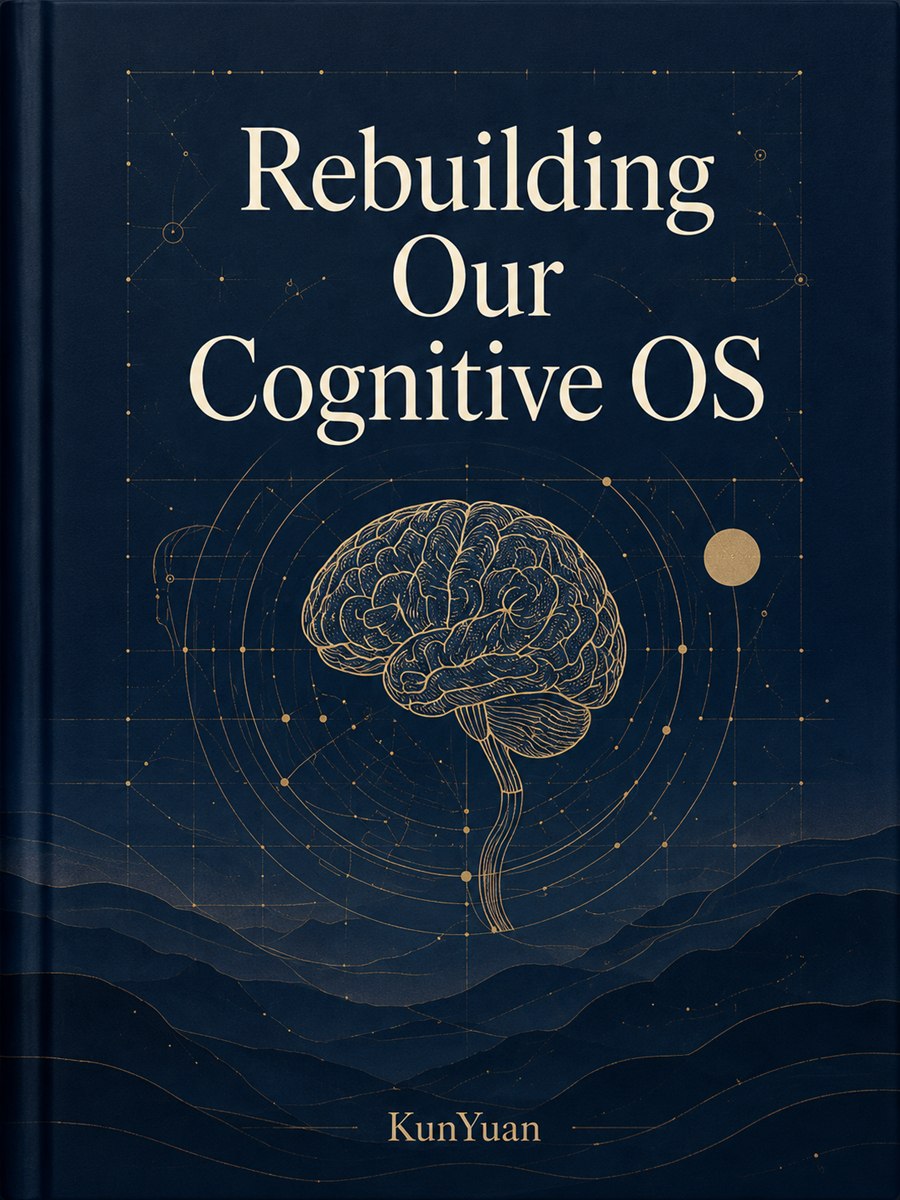
Cover of Rebuilding Our Cognitive OS by KunYuan
Cover · KunYuan
§ 01About the Book

Why can our capabilities grow so much while the way we understand the world stays the same?

A book about where our present way of understanding the world came from — and about the narrow, disciplined conditions under which it is worth reopening.

We often assume that stronger thinking naturally leads to deeper cognitive change. We read more, we learn better methods, and we become more analytical, more efficient, and more capable of searching, comparing, reasoning, and expressing ourselves. AI can now amplify these abilities even further. Yet a strange gap remains: a person may become far more capable while continuing to return to the same familiar interpretations, judgments, priorities, and patterns of life.

Rebuilding Our Cognitive OS begins precisely at that gap. Why can our cognitive capabilities become much stronger while the long-term organization that shapes how we understand, judge, and choose remains largely unchanged? The book separates greater capability from change in the deeper layer that coordinates those capabilities across time.

“Cognitive OS” is a metaphor for the cross-temporal organization of cognition. It does not suggest that the Human mind literally contains a computer operating system, nor that a person is software waiting to be optimized. The term is simply a way to make visible the usually hidden relationships through which attention, questions, concepts, evidence, judgment, action, and feedback become organized over time.

I have a Personal Cognitive OS, but I am not my Cognitive OS.

If the first book asks how I remain present in my own formation, the second moves one level deeper: how did this present-day “I” come to understand, judge, and respond to the world in the ways that now feel so natural? The body participates. Relations of dependence participate. Language, culture, education, and institutions participate. Past interpretations settle into today’s cognitive defaults, and the shared world has already entered us before we become capable of fully reflecting on how it happened.

But the book refuses the conclusion that formation means destiny. Understanding where we come from is not an attempt to give childhood, culture, history, or past experience permanent authority over the future. It is meant to help us distinguish where we naturally begin from where we must necessarily end.

§ 02Core Ideas

Three ideas the book keeps returning to.

i

We do not begin from zero

Our present way of understanding reality has a history. The body, relations of dependence, language, culture, education, institutions, and previous judgments all participate in how certain questions, explanations, and responses come to feel natural. A Personal Cognitive OS is the book’s way of observing this continuity across time.

ii

To be formed is not to be determined

Understanding how the past enters the present is not an argument for destiny. A cognitive default may explain why we naturally begin from a certain position without deciding where we must end. The book therefore treats formation history as something that can be understood, tested against present reality, and, when necessary, reopened.

iii

Rebuilding is not permanent self-optimization

Stable cognitive relationships are necessary because they allow learning to accumulate and life to continue without constant self-analysis. Rebuilding becomes relevant only when reality has changed, recurring misalignment remains after more local learning, and a stable cognitive relationship has sufficient reason to be reopened. The goal is not permanent introspection, but to let recalibrated abilities return to the background and continue living.

§ 03Contents

The complete table of contents of the final manuscript.

The full structure is listed here rather than summarized, so that the project can be assessed as a completed manuscript rather than an announced title.

18 chapters · afterword View full contents
  • 01Why Better Thinking Skills Do Not Mean Our Cognitive OS Has Changed
  • 02What Is Cognition, and Why Do We Still Need a “Personal Cognitive OS” to Understand Ourselves?
  • 03Why Can We See Traces of Our Personal Cognitive OS by Looking Back from a Choice?
  • 04How Do the Body and Relations of Dependence Shape How I Understand the World Before I Can Choose Independently?
  • 05How Do Language, Culture, Education, and Institutions Shape How I Understand the World, Approach Knowledge, and Form Judgments?
  • 06How Do Past Understandings and Judgments Settle into Today’s Cognitive Defaults?
  • 07How Does the Way I Understand Reality Shape My Choices and My Life?
  • 08Facing Complex Reality, How Do I First See Where I Stand?
  • 09From “What Happened?” to “Why Did It Happen?”: How Do We Form an Understanding of Reality?
  • 10Faced with Different Answers, How Do I Form a Grounded Judgment?
  • 11Judgment Can Tell Me What Is More Likely True, but Not What Is Worth Pursuing: How Does Direction Form?
  • 12Once Direction Has Formed, How Do I Turn a Possibility into My Own Choice?
  • 13How Does a Choice Enter Action, and How Do Real-World Results Return to Cognition?
  • 14Why Does Stability Make Life Possible, Yet Sometimes Leave the Past Out of Step with the Present?
  • 15After Seeing Structural Misalignment, When Is It Really Worth Reopening a Stable Cognitive Relationship?
  • 16Once a Stable Cognitive Relationship Is Reopened, How Does Rebuilding Actually Happen?
  • 17How Are Reformed Cognitive Relationships Recalibrated by Reality and Stabilized Again?
  • 18Once These Abilities Truly Become Ours, How Do We Let the Personal Cognitive OS Return to the Background and Keep Living?
  • AfterwordWhere Do I Come From?
§ 04The Trilogy

Where it sits in the RainbowCity Subjectivity Trilogy.

  1. 01
    The Author of Our Life Who am I? Subjectivity Awakening
  2. 02
    Rebuilding Our Cognitive OS Where do I come from? Subjectivity Formation
  3. 03
    《把方向留给自己》 Where am I going? Subjectivity Collaboration Book 3 · Forthcoming

I can be formed, but I cannot disappear from my own formation.

Forthcoming December 2026 · RainbowCity Press · TRANTOR LABS PRIVATE LIMITED

← All publications