AI is moving deeper into everyday life. It no longer only helps us search for information, write faster, or complete tasks. It increasingly participates in how questions are framed, how reality is explained, how options are organized, how judgments take shape, and how decisions move toward action.
As more of this cognitive work can be supported by another intelligence, a deeper question begins to emerge: when answers become easier to obtain, and when judgments can increasingly be organized before they reach us, where does the first-person “I” still remain?
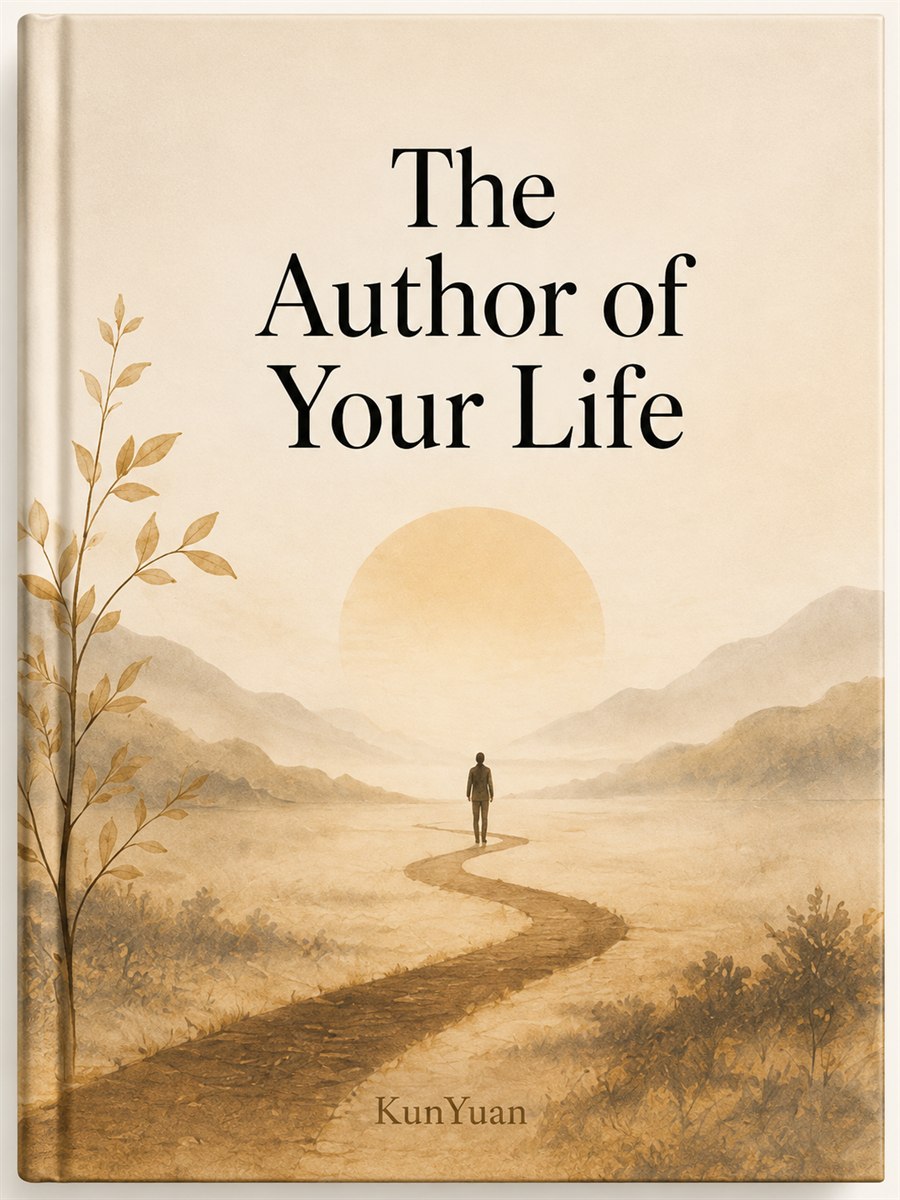
The Author of Our Life is a philosophical primer on subjectivity and cognitive sovereignty in the age of AI. It does not argue that AI should be kept outside human life, nor does it ask Human to reclaim every task that technology can perform. It welcomes stronger AI and deeper Human-AI collaboration, while insisting on one boundary.
The book is therefore not a handbook for using AI correctly, and it does not offer a method for producing better answers. It works on a smaller and more durable capacity: noticing, when something matters, that an answer has already arrived framed — and asking what the real question is, why this answer convinces us, whose standard is being applied, and what would still be able to change our minds, before returning to life and acting.
Written for everyday readers rather than specialists, it begins in ordinary experience — social media fatigue, the strangeness that follows convenience, the quiet unease of a life that has become easier to run and harder to recognize — and moves toward a philosophical account of subjectivity and cognitive sovereignty, ending with what it means to remain the author of a life that none of us was ever writing alone.